
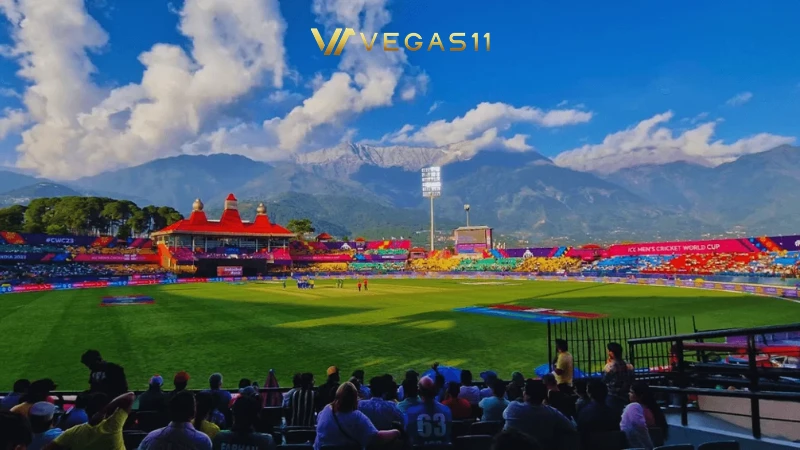

Dharamsala Cricket Stadium stops you in your tracks.
Not because of a gate check or a long queue. It stops you the moment you see it — the moment the Dhauladhar mountains appear above the sightscreen, white and still and enormous, and you realise that no photograph has ever done this place justice. The Dharamsala Cricket Stadium, also known as the HPCA Stadium, is routinely called the most beautiful cricket ground in India. In May 2026, it proved it is also one of the most important.
This is the story of how a ground that began as a college sports field became the stage for Indian cricket’s most spectacular nights — and why it is only going to get bigger.
Dharamsala Cricket Stadium: From College Ground to World Stage
The Dharamsala Cricket Stadium did not arrive fully formed. Its story begins in 2002, when the Prem Kumar Dhumal-led BJP government allocated land belonging to the Himachal Pradesh Education Department to the Himachal Pradesh Cricket Association (HPCA) on a token-amount lease. The ground was built within a year. It had limited seating at the time, and the first matches played there in 2003 were modest inter-district affairs.
The Dharamsala Cricket Stadium first entered the national conversation in March 2005, when a match between the India Board XI and Pakistan brought television cameras and journalists up into the Himalachal hills for the first time. They arrived to cover the cricket. They left talking about the mountains.
Since then, the HPCA Stadium has hosted five ICC World Cup matches, multiple India internationals, and seasons of the Indian Premier League as a home ground for the Punjab Kings. By 2026, the Dharamsala Cricket Stadium is not just beautiful — it is essential.
What Makes the Dharamsala Cricket Stadium Unique in the World
The Dharamsala Cricket Stadium sits at 1,457 metres above sea level in the Kangra district of Himachal Pradesh. No other international cricket venue in India comes close to that altitude. The thin mountain air means the ball travels farther on a cricket shot than at sea-level grounds — a fact that batsmen discover quickly and fast bowlers use just as shrewdly, getting extra carry and bounce that rewards swing and seam.
The playing surface is maintained with a ryegrass outfield that handles harsh Himalayan winters and stays green through the playing season. The pitch itself offers true bounce, rewarding stroke-makers while keeping fast bowlers central to the contest throughout an innings.
The stands are designed to be open and low — deliberately so — allowing mountain winds to sweep across the field. This keeps conditions fresh and challenging in a way that a closed, high-walled urban stadium cannot replicate. The architecture carries Tibetan design influences, a natural tribute to Dharamsala’s identity as the home of the Dalai Lama of Tibet and a town with deep cultural ties to the Tibetan community.
ESPNcricinfo, one of cricket’s most trusted publications, described the Dharamsala Cricket Stadium as being as picturesque as the Adelaide Oval and Newlands in Cape Town — two venues regularly voted among the world’s most beautiful sporting grounds — and said it may in fact be more beautiful than both. That is a high bar. The Dhauladhar range, visible in its entirety from every seat in the ground, makes the case without argument.
IPL 2026 Qualifier 1: The Night Dharamsala Cricket Stadium Made History
On May 26, 2026, the Dharamsala Cricket Stadium hosted IPL 2026 Qualifier 1 between defending champions Royal Challengers Bengaluru and Gujarat Titans. A place in the IPL 2026 Final was on the line. What followed was the kind of match that becomes part of a venue’s identity forever.
Royal Challengers Bengaluru won the toss and batted first. Virat Kohli walked out to open to a standing ovation from a packed ground of 23,000 spectators, scoring 43 before departing. Then Rajat Patidar arrived.
The RCB captain took the Dharamsala Cricket Stadium’s altitude and its fast outfield and turned them into weapons. He struck an unbeaten 93 off just 33 balls — nine sixes, five fours — as RCB plundered 114 runs in the final six overs alone. The final total: 254 for 5. It was the highest team total in the history of IPL playoff cricket.
Gujarat Titans, chasing 255, were bowled out for 162. RCB won by 92 runs, booking their place in the final.
At the innings break, the Dharamsala Cricket Stadium’s floodlights lit up a fireworks show above the boundary ropes. The snow on the Dhauladhar peaks caught the light. The 23,000 in the stands — a mix of RCB fans who had travelled from Bengaluru and locals who had hiked down from the hills — made a noise that bounced off the mountain face.
It was, by any measure, one of the great nights in Indian cricket.
Vegas11 News covered every ball of Qualifier 1 live — from toss reaction to final wicket. Follow Vegas11 News for IPL 2026 updates, match previews, and the on-ground stories that bring Indian cricket to life.
Dharamsala Cricket Stadium Expansion: Capacity Set to Grow to 30,000
The HPCA has heard what the packed stands have been saying for years.
The Himachal Pradesh Cricket Association is now formally exploring a plan to increase the Dharamsala Cricket Stadium’s seating capacity from approximately 22,000 to 30,000. A survey has already been conducted. HPCA Secretary Avneesh Parmar confirmed that the expansion will only proceed if one condition is guaranteed: the unobstructed view of the Dhauladhar mountain range from inside the stadium must not be blocked.
That condition is not a compromise. It is the whole point.
The Dharamsala Cricket Stadium receives spectators from across India — and increasingly from abroad — whenever IPL or international matches are hosted there. Every seat sold out for Qualifier 1. Every seat will sell out for the T20 World Cup 2026. The demand is there. The mountains are watching to make sure the character of the place is protected as the capacity grows.
T20 World Cup 2026 Is Coming to Dharamsala Cricket Stadium
The expansion plans are timed well. The Dharamsala Cricket Stadium has been confirmed as one of the venues for the ICC Men’s T20 World Cup 2026, co-hosted by India and Sri Lanka. It will be the grandest international stage the stadium has hosted, bringing teams and fans from every cricket-playing nation to the foot of the Himalayas.
International cricket. Floodlights. Mountains overhead. A stadium that began as a government college ground. The full schedule of World Cup fixtures at Dharamsala is yet to be confirmed, but the venue has already set its standard: there is nothing else like it anywhere.
Dharamsala Cricket Stadium: Key Facts at a Glance
| Detail | Information |
|---|---|
| Full Name | Himachal Pradesh Cricket Association Stadium |
| Location | Dharamsala, Kangra District, Himachal Pradesh |
| Altitude | 1,457 metres above sea level |
| Current Capacity | ~23,000 |
| Planned Capacity | 30,000 |
| First Match | Inter-district, 2003 |
| First International | India Board XI vs Pakistan, 2005 |
| First Full International | 2013 |
| IPL Home Team | Punjab Kings |
| ICC Events Hosted | 5 World Cup matches + T20 WC 2026 confirmed |
| Highest IPL Playoff Total | 254/5 — RCB vs GT Qualifier 1, May 26, 2026 |
Dharamsala Cricket Stadium and the Numbers That Define IPL 2026
Three IPL 2026 league matches were staged at the Dharamsala Cricket Stadium before Qualifier 1 arrived. In each of those three completed matches, the first-innings total either reached or crossed 200 runs. The old reputation of the ground as a bowler’s paradise — which held for years — has evolved into something more balanced: a venue where pace bowlers remain relevant but batsmen now dominate when the conditions allow.
Under lights, the Dharamsala Cricket Stadium tends to assist chasers, with dew arriving even in the peak summer months of April and May. The high outfield and altitude mean the ball reaches the boundary faster than almost anywhere else in Indian cricket. For T20 formats in particular, the Dharamsala Cricket Stadium has become a spectacle-generator.
The IPL numbers at Dharamsala across its limited fixtures back this up comprehensively. It is a venue that produces cricket worth watching — and a backdrop that makes watching it feel like a privilege.
The Moment That Stays With You at Dharamsala Cricket Stadium
There is a specific moment at the Dharamsala Cricket Stadium that every visitor describes the same way.
A batter — it could be anyone; it has happened many times — launches a six toward the long-on boundary. The ball rises. It clears the rope. And then it keeps rising, higher than it should by any normal calculation, climbing against the dark blue Himalayan sky, until for a fraction of a second it seems to be heading straight for the white peaks of the Dhauladhar range behind the stadium.
That is what altitude does at 1,457 metres. That is what the thin mountain air does to a well-struck cricket ball.
That is what the Dharamsala Cricket Stadium does to people who watch it.
Rajat Patidar hit nine of those moments on May 26, 2026. The 23,000 people in the ground screamed for every one. The mountains, as always, said nothing. They did not need to.
Related News: IPL 2026 Final: RCB Beat GT, Kohli Wins the Trophy | IPL 2026 Playoffs: RCB, GT, SRH & RR Fight for Glory